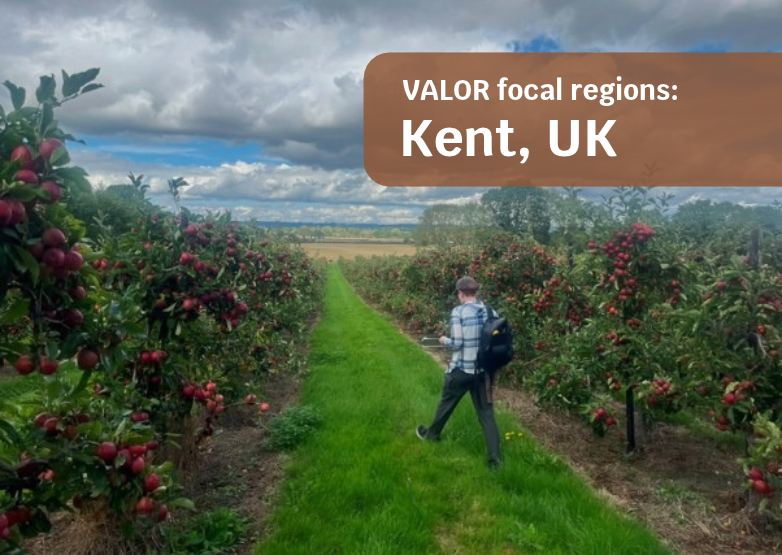
Introducing the VALOR Focal Regions: Kent, UK
Kent is located in the south-east of England, and is known locally as the “Garden of England” due to its warm annual temperatures, rolling hills and open landscapes with fertile soils, which make it a perfect location growing a variety of crops. The region is filled with picturesque towns and villages, as well as numerous medieval castles, and coastlines, which collectively encompass large regions of formal gardens. It is also home to important and rare habitats including ancient woodland, acid and calcareous grasslands, sand and shingle beaches, sand dunes and saltmarshes. Rare plant and pollinator species only found in Kent include the Late Spider Orchid, Ophrys fuciflora, and the Fiery Clearwing Moth, Pyropteron chrysidiformis.
Kent is the principal apple growing region (Fig. 1) in the UK, with many other tree, cereal and soft fruit crops, also grown in the region. The county also has a history of hop cultivation dating back to the early 16th century, and many traditional oast houses, with their distinct conical roofs for drying harvested hops, can still be seen throughout the county.
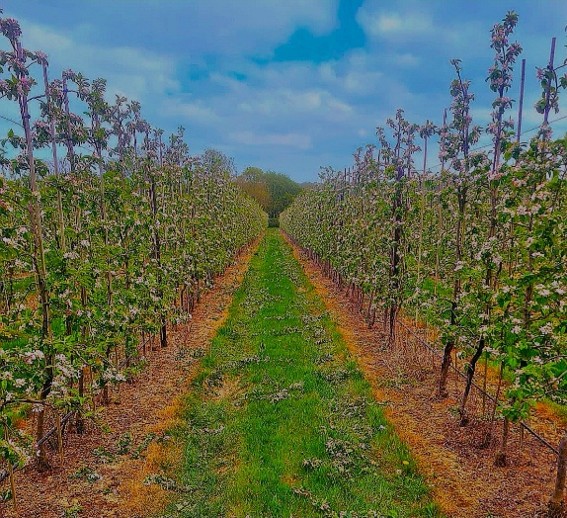 Apple Orchard in Kent. Photo credit: Louise Hutchinson
Due to its agricultural and ecological value, as well as long standing collaborations between apple growers and University of Reading researchers, Kent was chosen as the UK’s VALOR focal region.
In spring, summer and autumn this year, Postdoctoral Researcher, Dr. Louise Hutchinson and Professor Michael Garratt, alongside several Postdocs and PhD students at the university, investigated plant-pollinator interactions in different habitat types; apple orchards, including trees and alleys, semi-natural grasslands, woodland edges, arable margins, hedgerows and their undergrowth, and roadside verges.
Plant and pollinator abundance and diversity were highest during the first 2 rounds of surveys in mid-spring (late April/early May), and mid-summer (late June/early July). Ongoing heatwaves and droughts caused a sharp reduction in plant and pollinator presence along sampling points in late summer (mid to late August) and early Autumn (mid-September).
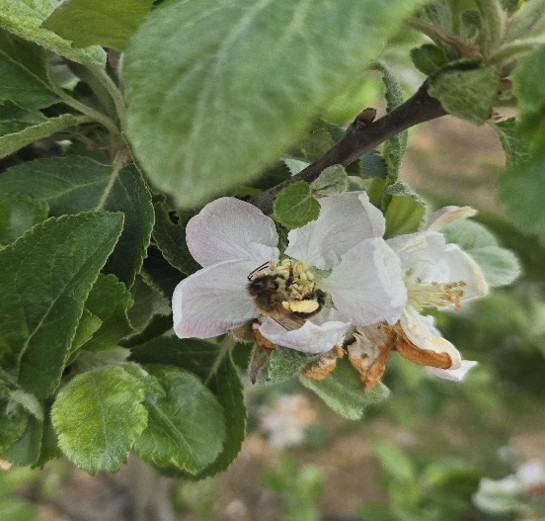 Figure 2: Andrena sp. on Apple
During the flowering season for pollinators, apple trees (Malus domestica) were a key floral resource for pollinators, along with Dandelions (Taraxacum agg.) growing along orchard alleys, and Hawthorn (Crataegus monogyna) in hedgerows. Pollinator visitors to these flowers included a number of solitary bees, such as Andrena spp. (Fig. 2), and hoverflies, such as Eupeodes spp. (Fig. 3) and Platycheirus spp. (Fig. 4).
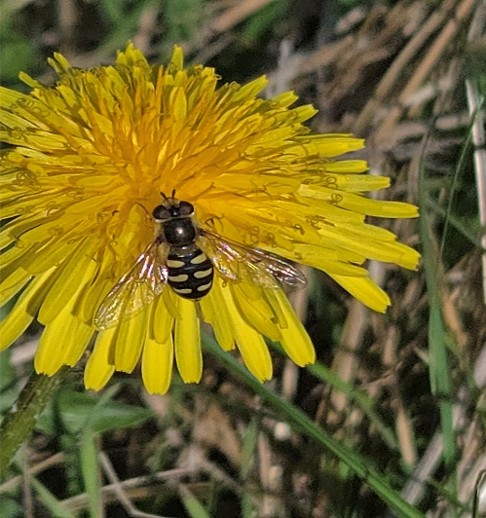
Figure 3: Eupeodes sp. on Dandelion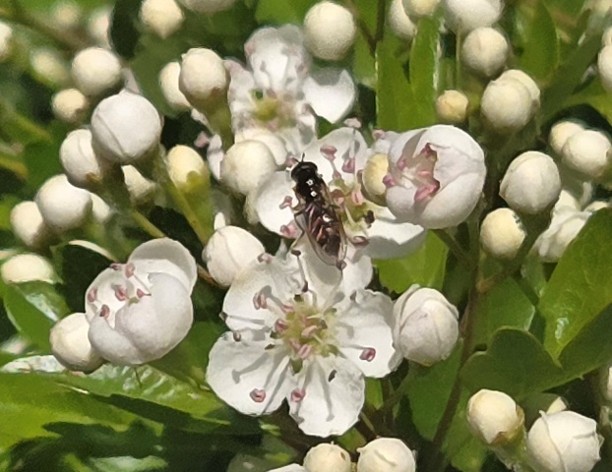 Figure 4: Platycherius sp. on Hawthorn
In spring and mid-summer rounds (April to June), we also conducted bird surveys using the Merlin app to identify breeding birds in, and around, each habitat type. In summer this required very early starts, as subsequent plant-pollinator surveys had to be completed by midday at the latest, due the afternoon high temperatures, that were unsuitable for pollinators and researchers alike.
This proved to be challenging, but incredibly rewarding, as not only were 37 species of birds recorded, including Barn Swallows (Hirundo rustica), Blackcaps (Sylvia atricapilla), Goldfinches (Carduelis carduelis), Song Thrushes (Turdus philomelos), and Yellowhammers (Emberiza citronella). Other dawn wildlife sightins included Fox cubs (Vulpes vulpes) in woodland areas, and Roe deer (Capreolus capreolus) amongst tree row’s in orchards (Fig.5).
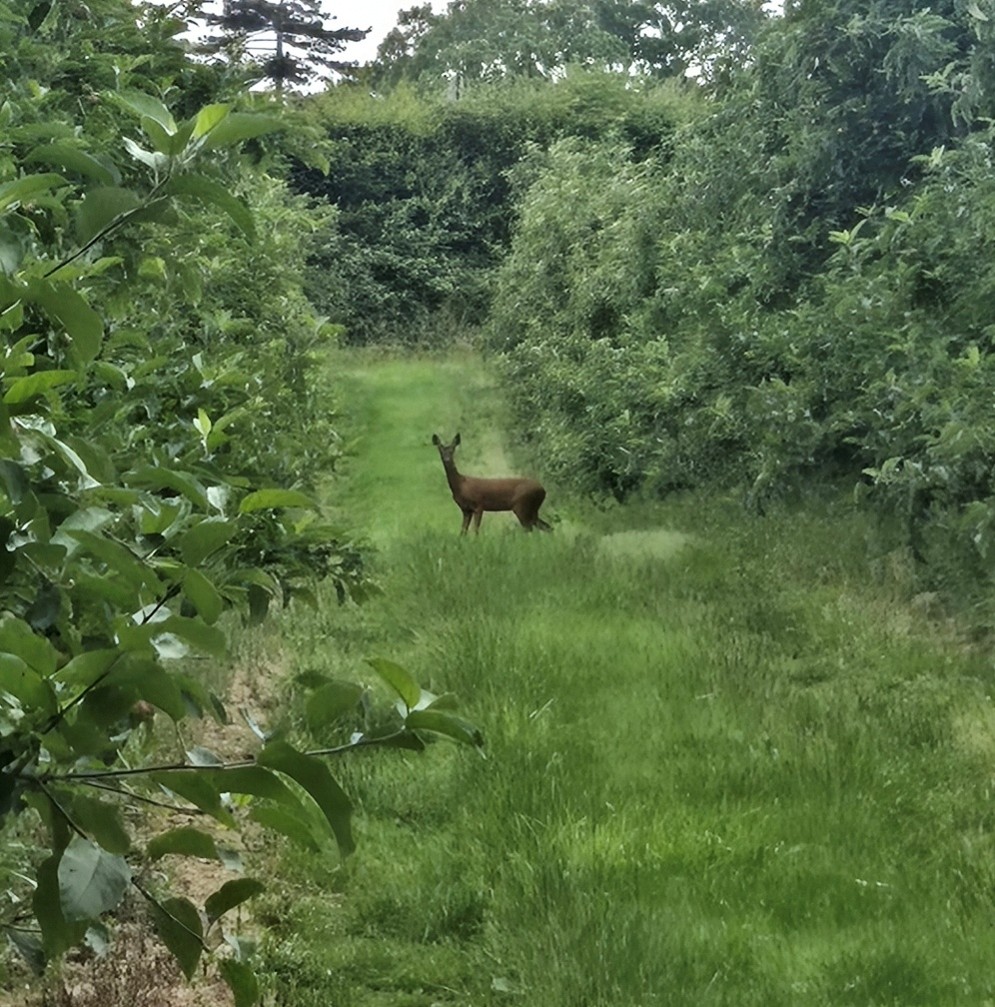 Figure 5. Roe Deer in Apple Orchard. Photo credit: Louise Hutchinson
After successive heatwaves, with temperatures frequently around 30°C and higher from late May on, both plant and pollinator numbers on surveys reduced dramatically in late summer and autumn. Few plants in hedgerows, arable margins and woodland edge had survived, and in orchards apple flowers had long gone over, with many intermediate grassy rows largely bare due to dry soils. Some of the grassland habitats still provided floral resources for pollinators, but were largely dominated by Autumn Hawkbit (Scorzoneroides autumnalis), Bristly Oxtongue (Helminthotheca echioides), Ragwort (Senecio jacobaea) and Smooth Hawksbeard (Crepis capillaris), compared to more diverse flora encompassing over 30 species earlier in the year.
The later surveys did give an unique opportunity, however, to see apples develop (Fig. 6), and subsequently witness hand harvesting by workers across the five orchard sites included in our fieldwork. There are still specimens to process from fieldwork, so it is too early to summarise results. But our fieldwork has already prompted thoughtful reflections upon how habitats, and wider landscapes, change throughout the seasons, and respond to climatic extremes, and the implications for the future of plant and pollinator surveys.
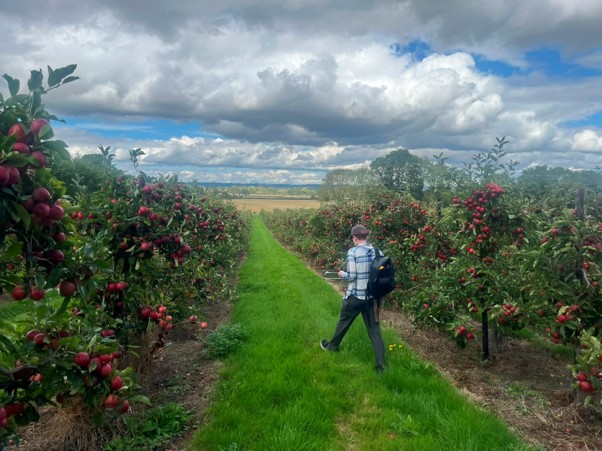 Figure 6. Louise Hutchinson in apple orchard. Photo credit: Leila Nicholson.
We look forward to sharing these, along with the results from this years fieldwork, with our fellow VALOR project partners in the months ahead.
Did you enjoy this read? Learn more about Güímar Valley in Tenerife, another VALOR focal region.