Introducing the VALOR Focal Regions: Güímar Valley, Tenerife
The following text was written by Carlos Ruiz Carreira (University of La Laguna).
The Güímar Valley is an arid valley nested on the southern slopes of Tenerife in the Canary Islands (Spain). The region is characterised by an intensive agricultural landscape dominated by smallholder farming. Here, a diverse range of traditional crops thrives, including local vegetables, fruit orchards, vineyards, and bananas.
Over the last decade, the valley has experienced a significant rise in several highly pollinator-dependent subtropical crops. Most notably, avocado (Persea americana), alongside mangos and pitaya (dragon fruit) for global fruit markets, and moringa and aloe for the medicinal sector. Beyond its agricultural importance, the Güímar Valley boasts exceptional ecological value. It supports numerous endemic plants, such as two endemic Persea trees as well as important pollinators, including several endangered species. A prime example is Anthophora pulverosa, an endemic bee classified as Vulnerable that recently graced the cover of the European Red List of Bees.
Among these natural treasures, the valley features one of the best-preserved coastal scrublands in Tenerife, the Malpaís de Güímar (Fig.1), alongside a striking transition into pine forest and laurel forests.
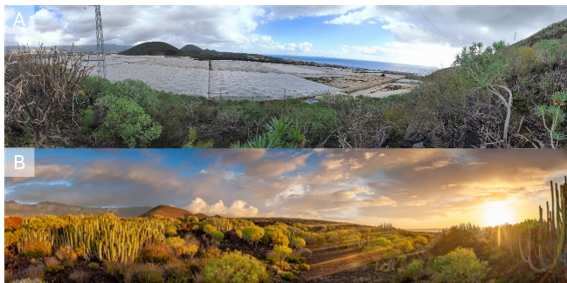 Figure 1: Panoramic overview of the natural and agricultural landscapes of the Güímar Valley, highlighting: a) greenhouses dedicated to subtropical fruit cultivation, and b) the protected coastal scrubland of Malpaís de Güímar. Photo credits: a) Carlos Ruiz, b) Gustavo Peña
Because of these ecological and agricultural values, the Güímar Valley was selected as one of the focal regions in the VALOR project. Our most recent fieldwork in the valley began in February and ended in early May. It involved the collection of plant-pollinator interaction network data across different habitat patches, including agricultural, seminatural, and natural habitats (Fig. 2).
Flowering in natural and seminatural habitats started surprisingly early, already in mid-January, quickly transforming otherwise dry-looking landscapes into patches rich in floral resources. The greatest abundance of flowers was recorded during February and March, when many plant species flowered almost simultaneously. However, this burst of flowering was relatively brief, something very characteristic of xeric habitats, where plants take advantage of short windows of suitable conditions to reproduce before water becomes limiting again.
Between sampling campaigns, floral abundance often dropped sharply, creating periods in which flowers became noticeably scarce across the landscape. Yet these systems also showed a remarkable capacity to respond to environmental change. Following local rainfall events in April, several plant species flowered again, producing a smaller but clear second pulse of blooms that became evident during the May sampling campaign. It was a reminder of how strongly flowering dynamics in dry habitats can depend on rainfall, and how rapidly these ecosystems can “reactivate” after precipitation.
In the organic avocado and mango farms (Fig. 2), flowering followed a different rhythm. Crop flowering began later, around February, and reached its maximum in early April. By May, however, most avocado and mango trees had already finished flowering, leaving the orchards with very limited floral resources. At first glance, this could suggest a difficult period for pollinators. However, field observations revealed a different picture: native and spontaneous vegetation growing between crops, along edges, and in surrounding areas continued to provide flowers, allowing pollinator activity to persist even after the crops themselves had stopped blooming.
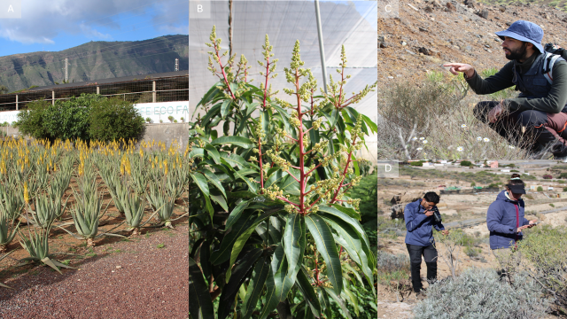 Figure 2. Study site and fieldwork. A. Aloe vera crop. B. Inflorescence of mango (Mangifera indica) in a green house. C. Floral resources sampling; in each transect the total number of open flowers per species are scored. D. Pollinator sampling; in each transect, the total number of plant-pollinator interactions are annotated. If the pollinator is not identified in the field, a photograph is taken or the individual is collected. Photo credits: Rebecca Magdalena Kropp (A, B, C, D).
Regarding pollinators, one of the most interesting findings was that species richness did not differ significantly among habitat types. In other words, an organic avocado farm could host a surprisingly similar number of pollinator species to a nearby natural area. At first glance, this might suggest that both habitats are equally suitable for pollinators. However, looking more closely at who was actually present revealed a much more nuanced picture.
The pollinator communities themselves differed considerably between habitats (Fig. 3). In organic farms, much of the pollinator assemblage was dominated by widespread, adaptable generalist species, particularly flies, which seemed well able to exploit the floral resources available in agricultural settings. Even so, the farms were not exclusively used by common species: some endemic bees were also observed visiting native plants growing between avocado and mango trees, suggesting that these remnant floral resources can still provide valuable feeding opportunities, increasing pollinator diversity and pollination service in these crops. Natural habitats, however, told a different story. Here, pollinator communities contained a greater proportion of endemic species overall, including many endemic bees, giving these areas a more distinct ecological identity.
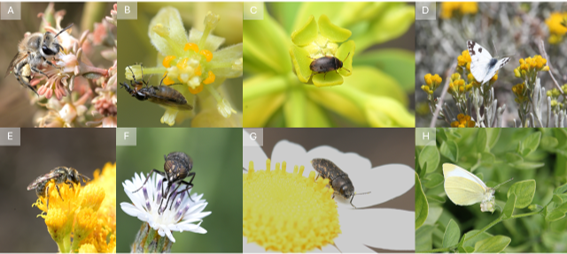 Figure 3. Diversity of pollinators observed during the fieldwork. A. Colletes moricei, B. Dilophus beckeri on avocado flower, C. Anaspis proteus, D. Pontia daplidice, E. Lasioglossum viride, F. Stomorhina lunata, G. Acmaeodera cisti, and H. Pieris rapae. Photo credits: Molaye Mohammed-Ahid (A-C, E-G), Rebecca Magdalena Kropp (D, H).
Taken together, these findings suggest that organic farms can support relatively diverse pollinator assemblages, but they do not entirely replace the ecological role of natural habitats. The persistence of native vegetation within farms appears particularly important, creating small refuges and foraging opportunities that may help endemic pollinators move across fragmented landscapes. In this sense, conserving or restoring patches of native vegetation inside and around agricultural land could make a meaningful contribution to maintaining pollinator diversity and strengthening ecological connectivity at the landscape scale.
Learn more about ULL's role in VALOR: