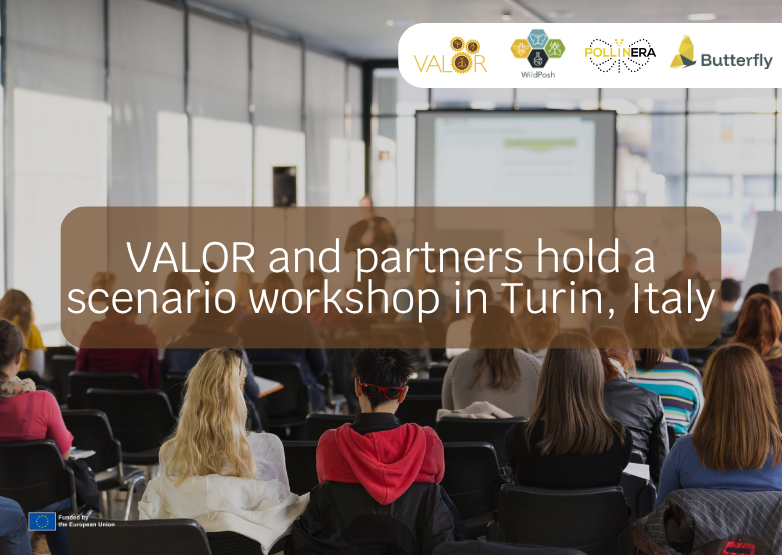
VALOR and partners hold a scenario workshop in Turin, Italy
The world is a deeply uncertain place, so it is no surprise that researchers often try to imagine the future to better anticipate the actions we need to take in the present. When the VALOR project was being developed, scenarios were given a prominent role, with an entire work package dedicated to them (Work Package 6 - Forecasting and enhancing resilience of society and pollinators under changing future conditions). While many future scenarios already exist, most are very broad and do not provide the level of detail needed to assess what future changes might mean specifically for pollinators, and what that could mean for society and the economy.
On 16–17 February 2026, the VALOR project, in collaboration with the WildPosh, PollinERA, and Butterfly projects, organised a future scenarios workshop in Turin, Italy, bringing together 12 stakeholders from NGOs, industry, and policy. The workshop was organised alongside the WildPosh Annual General Meeting and focused on exploring possible futures for pollinators, society, and the economy under different policy pathways.
Future scenarios play an important role in research because they help scientists and policymakers better understand uncertainty and prepare for different possible developments. Within VALOR, scenarios are a central part of the project and are addressed under Work Package 6. While many global scenarios already exist, they are often too broad to capture the level of detail needed to understand what future changes could mean specifically for pollinators and for sectors that depend on them. For this reason, the projects worked together to develop new, policy-focused scenarios.
The workshop focused on a central question: “What happens if key EU policies around pollinators succeed or fail?” More specifically, the discussions were focused on:
- The Nature Restoration Regulation: A recent policy that sets binding targets for member states to restore their rare habitats, common birds, soils and pollinators by 2050.
- The Sustainable Use Directive: an older regulation that requires member states to reduce the risks from pesticides.
Based on these two policies, participants developed four future scenarios: one where both policies fail, one where both succeed, and two where only one of the policies succeeds.
During the first day of the workshop, participants explored what the world might look like in each of these futures and how these situations might come about. These discussions resulted in four different and detailed visions of the future. The diverse group of stakeholders helped enrich the scenarios with practical perspectives and realistic detail.
The second day asked the participants to imagine what the consequences of these changes would be on nine different aspects of the way we manage the land and grow food across Europe. Naturally, there’s a lot of uncertainty around this, but the session was engaging, promoting fruitful and memorable discussions leading to a consensus. The participants capped it off by discussing the ways that the scenarios were vulnerable to different shocks (sudden, severe events like extreme weather, trade wars, and pest outbreaks).
The scenarios will now be further refined and will form the basis for future modelling and analysis across the four projects. Each project will adapt the scenarios to its own research needs. Butterfly will adapt scenarios into business-facing scenarios and look to explore how different types of ecoliteracy could help us avoid certain outcomes. WildPosh will build comprehensive risk models for its key pollinator species, considering how the land use could modulate changes in pesticide use, and PollinERA will use them as the basis for their more complex models of future risk. Within VALOR, the scenarios will be used to explore how different futures could affect land use and farming across the project’s seven focal regions.
The conversation doesn’t just end here, too - these scenarios, and the results of the models that emerge from them, are expected to help shape the conversation about how we support pollinators and the people who depend upon them and to capture the imagination of people from across Europe. So, expect to see some colourful descriptions from us in the near future!