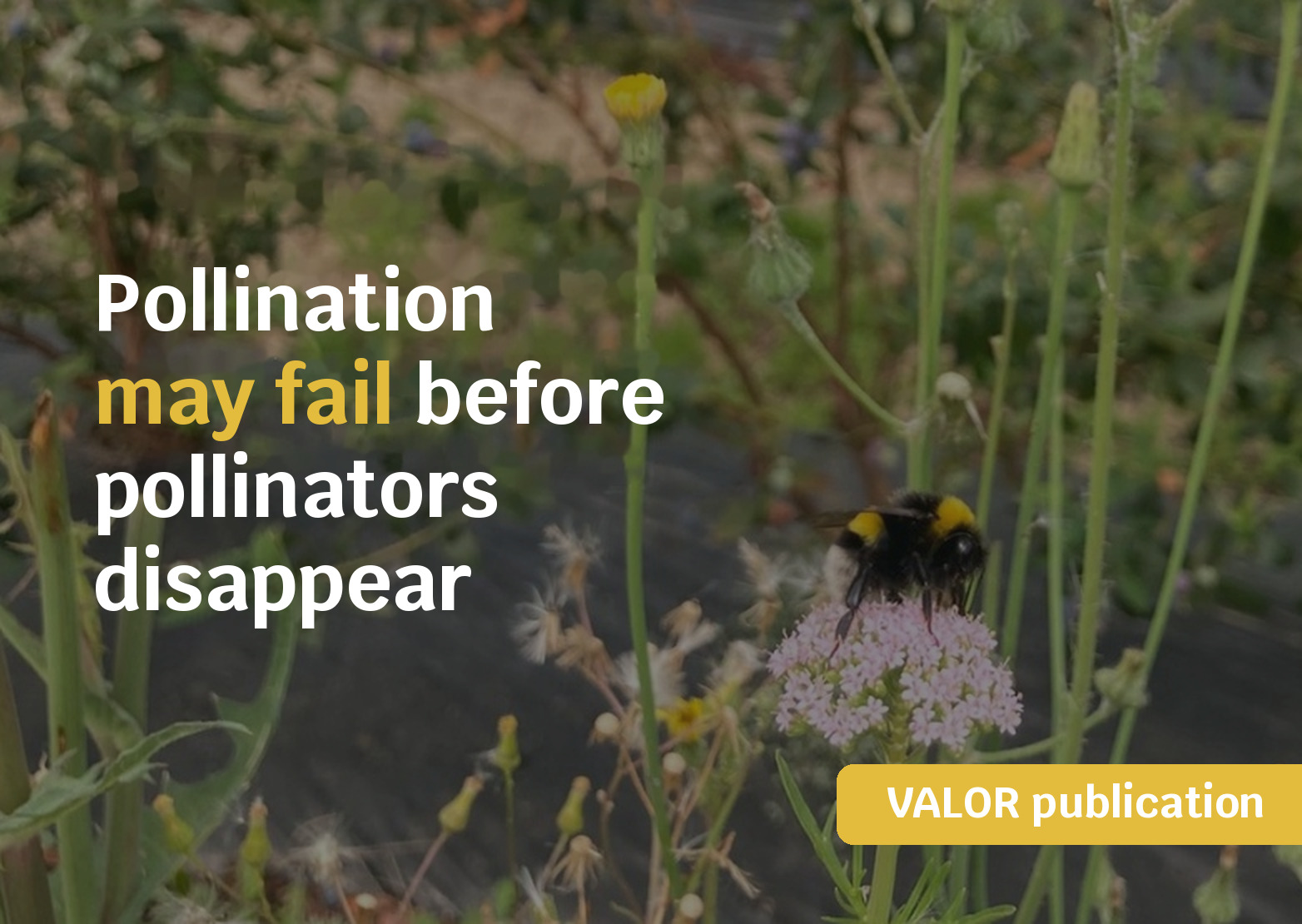
Scientists call for measuring pollination, not just counting pollinators
Animal pollination is one of nature's oldest partnerships, but it is being reshaped faster than ever. In a new review in the Annual Review of Environment and Resources, VALOR researchers from CSIC look at how human-induced rapid environmental change affects pollination itself, not just pollinators.
Animal pollination first appeared around 280 million years ago, and it drove the diversification of both flowering plants and their pollinators. Today, nearly 90% of flowering plant species and more than 75% of crops depend on animals to reproduce fully. Most research tracks how many pollinators there are or how often they visit flowers. The authors argue that there is another angle to consider.
Their framework splits pollination into two parts. The first is interaction probability: whether a plant and a pollinator meet at all. Land use change, pesticides, invasive species and climate change all lower this probability. They shrink populations, and they push species out of step in timing (phenological mismatch) or in space (range shifts). The second is interaction efficiency: how much good-quality, compatible pollen actually reaches the flower. This part gets much less attention. Warming, for example, shortens the receptive period of faba bean stigmas, and bees that develop at higher temperatures grow smaller. Heatwaves can cut pollen production and seed set outright, and night-time light pollution reduces flower visits.
Few studies measure the pollen that is actually deposited on flowers, which is the step that links environmental pressures to plant reproduction. To close that gap, the authors propose pollen limitation as a unifying indicator.
Pollen limitation is the shortfall between the seeds a plant could produce and the seeds it actually produces because it received too little pollen or the wrong pollen. Because it captures both the quantity and the quality of pollen, it shows the real cost to plants. That cost is already visible: threatened plant species show 26% higher pollen limitation than non-threatened ones.
To move the field forward, the authors call for:
- Tracing the full path from environmental pressures to pollinator populations, visits, pollen deposition and plant reproduction, using a Driver-Pressure-State-Impact-Response framework that includes the social and political causes behind the pressures.
- Studying multiple pressures together, since climate and land use change often amplify each other's effects.
- New monitoring tools, such as automated cameras with AI image recognition and pollen tracers like quantum dots, plus open sharing of time-consuming field data.
- Boosting biodiversity as the best overall insurance, because diverse pollinator communities buffer mismatches and make sure each plant finds an efficient partner.
The message is urgent but cautiously optimistic. The loss of an ecological function usually comes before the loss of species, so declining pollination is an early warning worth acting on. At the same time, very few pollinator species have gone extinct globally, and most are insects whose populations can rebound quickly once conditions improve. The authors conclude that the tools to halt the decline already exist, and the time to use them is now.
Read the full article.