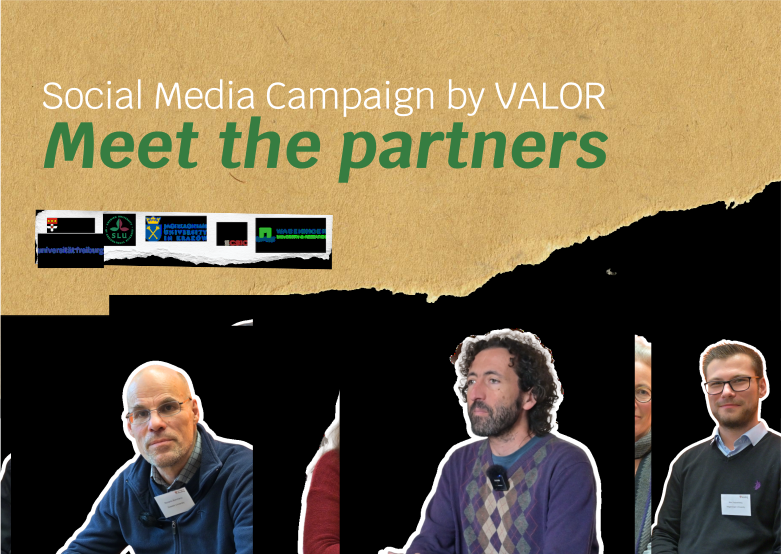
Meet the partners: VALOR social media campaign introducing institutions
VALOR brings together thirteen institutions spanning pollinator ecology, economics, sociology, stakeholder engagement and science policy. To introduce each partner and explain their role in the project, VALOR has launched a video campaign: Meet the partners.
Follow all the videos on YouTube, Bluesky and LinkedIn under the hashtag #VALORpartners.
1. University of Reading
Presented by project coordinator Tom Breeze, University of Reading, coordinates the VALOR project. It provides the scientific leadership that ties the consortium together. Beyond coordination, Reading's team is actively involved across all areas of the project: from leading research in the UK focal region to advancing the understanding of how pollinator visitation affects crop yields, co-developing scenarios of future European land use.
2. Swedish University of Agricultural Sciences
Represented by Riccardo Bommarco, the Swedish University of Agricultural Sciences (SLU) leads VALOR's work on multi-actor engagement, bringing together farmers, policymakers, researchers and other stakeholders. In VALOR, SLU also conducts analysis to understand how pollinators feature in European policy and governance, and creates economic models of pollination services at the farm level.
3. Albert-Ludwigs-Universität Freiburg
The Albert-Ludwigs-Universität Freiburg is presented by Alexandra Klein, who leads the work on synthesising existing knowledge about pollination services across Europe, building shared databases and assessing where pollination services are most vulnerable. Freiburg also brings a direct connection to the Horizon Europe project RestPoll, coordinated by Alexandra, creating a valuable link between VALOR and ongoing work on wild pollinator restoration through Living Labs across Europe.
4. Jagiellonian University
Represented by Hajnalka Szentgyörgyi, the Jagiellonian University in Kraków is one of the oldest universities in Europe. Two research groups contribute to VALOR: one focused on pollinator ecology, leading empirical data collection at the Polish focal site, and one specialising in socio-environmental research, contributing to stakeholder engagement and the socioeconomic dimensions of the project.
5. Spanish National Research Council
The Doñana Biological Station, part of the Spanish National Research Council (CSIC) and presented by Ignasi Bartomeus, leads VALOR's work on the dependence of natural ecosystems on pollinators. The team coordinates the collection of empirical data across Europe to understand how pollinator interaction networks affect ecosystem stability, using cutting-edge modelling techniques. EBD-CSIC also leads the Spanish case study, gathering ecological, social, and economic data around the emblematic Doñana National Park.
6. Wageningen University
Wageningen University, presented by Miranda Meuwissen and Maximilian Koppenberg, will contribute towards VALOR with two groups. The Business Economics Group will analyse the importance of pollination for value creation in food, energy, medical, bio-based material and feed value chains. While the Plant Ecology and Nature Conservation Group focuses on natural ecosystems, identifying which habitats are most vulnerable and analysing how plant communities respond to falling pollinator populations.
More partner videos are on the way. To learn more about the institutions involved in VALOR, visit the dedicated page.